Dining Table Lighting: How to Light It Well

In this article
The best dining table lighting starts with one warm, dimmable fitting centred over the table. Add softer light at the edges of the room, then choose bulbs and controls so the same table can handle a quiet supper, homework and a long dinner party. Get the height, width and warmth of that central light right and most of the work is done.
Below, we walk through the fitting types that suit a table, how to hang them, how to avoid glare and shadow, which colour temperature to choose, and how to handle reading, laptops and serving.
TL;DR
- Centre a pendant, linear fitting or semi-flush light over the table, and keep it narrower than the table so nobody is knocked by it or dazzled by it.
- Hang it low enough to feel intimate and high enough that seated guests can see each other. Check the maker’s guidance for your ceiling height and fitting before you cut the cable.
- Layer the room: overhead light, softer background light, and a lamp or two at eye level, all on dimmers where possible.
- Choose warm white LEDs, around 2700 to 3000K, and keep the colour temperature consistent across every fitting in the room.
- For homework, reading or serving, add flexible task light rather than brightening the whole room.
Table of Contents
- Start with the job the table does
- The main types of light above a dining table
- Height and size: getting the proportions right
- Avoiding glare and dark spots
- Layering light so the room adapts
- Warmth, dimming and colour rendering
- Task lighting ideas for a table that works hard
- Table shape, ceiling height and room type
- Perspective: why we make dining lights from wood
- Choosing your wood and checking the finish
- Find a dining light made for your table
- A simple plan to follow
- FAQ
- Sources
Start with the job the table does
A dining table is rarely only a dining table. It is where the post is sorted, the laptop opens on a Tuesday afternoon and children spread out their coursework. In the evening it becomes a candlelit centrepiece. Lighting has to flex between those moods, which is why a single bright ceiling fitting on an on/off switch so often leaves a dining room feeling like a canteen.
Before you choose a fitting, answer three questions:
- What shape and length is the table? Round and square tables suit a single central light. Long rectangular tables suit a linear fitting or a row of pendants.
- How high is the ceiling? Low ceilings call for a flush or semi-flush fitting, or a slim pendant that does not intrude. Tall ceilings can carry a longer drop or a sculptural piece.
- What else happens here? If the table doubles as a desk or a craft space, plan task light from the start.
Plan the lighting at the same time as the furniture. The table’s size and position decide where the fitting sits, and it is far easier to place a ceiling point correctly than to move one later. Interior designers make the same point about planning lighting alongside the furniture layout, because the scale and use of the table dictate the type of light it needs.
The main types of light above a dining table
Pendants
A pendant is the classic answer, and for good reason. It sits directly over the table, defines the dining area (especially useful in open-plan rooms) and gives a clear focal point. A single wide pendant suits a round or square table. On a longer table, a row of two or three smaller pendants spaces the light more evenly.
Wood is a natural choice here. It softens the glow, adds warmth even when the light is off and looks at home beside an oak or walnut table. Our Oak Wood LED Pendant Light in a Scandinavian style is one example, and our Walnut Triangle LED Pendant shows how a geometric shape can read as sculpture over a table.
Linear fittings
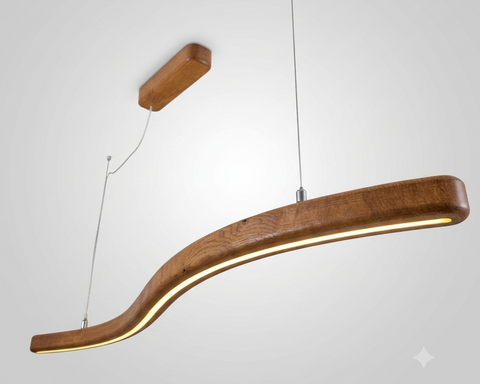
For rectangular tables, particularly long ones seating six to ten, a linear fitting mirrors the shape of the table below it. The light is spread along the length rather than concentrated in one spot, so the far end of the table is not left dim. Our Oak LED Linear Pendant is made to measure in the UK, so the length can follow your table rather than the other way round.
Chandeliers
A chandelier brings a more formal presence. A minimalist take works well in contemporary rooms: a handmade oak LED chandelier gives you the multi-point spread of a traditional chandelier with cleaner lines.
Flush and semi-flush lights
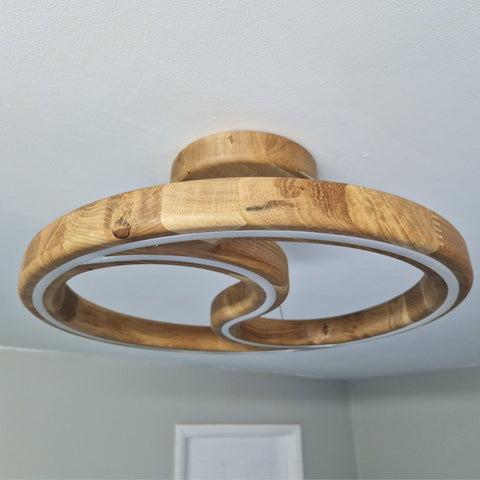
Where the ceiling is low, a drop of any length can become a hazard for tall guests. A flush or semi-flush ceiling light keeps the headroom and, if it is designed with both direct and indirect light, bounces a soft glow off the ceiling too. Consider our direct and indirect wooden LED ceiling light, or the Alexa-compatible version if you would like voice control.
Height and size: getting the proportions right
This is where most dining rooms go wrong, and it is simple to fix.
Width. A good rule of thumb is that the fitting should be clearly narrower than the table, leaving generous space at each side so chairs can be pulled out and nobody leans into it. A very large fitting over a small table crowds the room, and a tiny one over a large table looks lost.
Height. Hang the fitting low enough to create a pool of light and a sense of intimacy, but high enough that people seated opposite can see each other’s faces and nobody catches their head when standing. Many lighting guides suggest a drop of roughly 60 to 80 cm between the tabletop and the underside of the fitting. Treat that as a starting point rather than a law. An open shade that shows the bulb needs to hang a touch higher to avoid glare, and a closed or diffused shade can come a little lower. Taller ceilings generally allow the fitting to sit slightly higher.
Position. Centre the fitting on the table, not on the room, if the two do not line up. The table is what you are lighting. If the ceiling point is already fixed in the wrong place, a long linear fitting or a pair of pendants can disguise a small offset far better than a single drop can.
Test before you commit. Cut a cardboard template to the fitting’s size, hang it from a string at the planned height and sit at the table. Check sightlines, headroom and whether it feels too heavy. It takes ten minutes and saves a lot of regret.
Because every piece we make is made to order, size and drop can be tailored to the table and ceiling you actually have. If you are unsure, our bespoke lights page is the place to start.

Avoiding glare and dark spots
Even light is the aim. A single intense source creates a bright patch on the table and deep shadow around it. That is uncomfortable for everyone, and particularly for people with sight loss. The Macular Society advises using several lights for an even spread, shading bulbs so they are not directly visible, and using uplighters to bounce light from the ceiling. It also warns that isolated spotlights can produce confusing bright and dark patches and glare.
In a dining room, that translates into a few easy habits:
- Shade the source. A diffuser, wooden slats or a deep shade stop the bulb dazzling seated guests.
- Mix direct and indirect light. Light that bounces off the ceiling fills in the shadows that a downlight alone leaves behind.
- Avoid a single row of downlights. Recessed spots directly above the table create hot spots on the surface and shadows under every brow.
- Mind reflective tabletops. Glossy surfaces bounce a bare bulb straight back into the eye. Matte or oiled wood is far more forgiving.
Layering light so the room adapts
Layering simply means using more than one type of light and controlling each separately.
The overhead layer
This is your pendant, linear or flush fitting. It does the main work over the table and should always be on a dimmer.
The ambient layer
Wall lights, uplighters or a lamp on a sideboard soften the corners and stop the room from feeling like a dark box with a bright centre. They bring light to the walls and to eye level, which flatters faces far more than light from above.
The accent layer
A picture light, a glow along a shelf or a table lamp on a dresser adds depth. It is the layer people forget, and it is what makes a dining room feel finished.
If you want to think more about light as part of the space rather than just a fitting, our journal piece on designing light as a spatial tool goes deeper.
Our table lamps and floor lamps fit neatly into the ambient layer, and they bring the same wooden craftsmanship to the corners of the room.
Warmth, dimming and colour rendering
Colour temperature is measured in kelvins (K). Lower numbers glow golden, like candlelight; higher numbers look whiter and bluer. For dining, you want warm.
The Energy Saving Trust notes that 2700 to 3000K suits most general household lighting, while cool white can feel harsh at home. For a dining table, that range gives skin and food a flattering golden warmth without turning everything orange.
Three points matter most:
- Be consistent. Use the same colour temperature in every fitting in the room. A cooler pendant beside warmer wall lights looks like a mistake, not a choice.
- Look at CRI. The colour rendering index describes how faithfully a light shows colours. A higher CRI makes food, wine and wood grain look natural. When you order a made-to-order light from us, CRI and colour temperature are options you can choose.
- Always dim. Full brightness for laying the table and clearing up, a low glow for dinner. Dimming is what turns a functional room into a cosy one. Our lights can be specified with dimmable, remote or Alexa controls.
We also suggest asking about warm-dim options if you want the light to grow warmer as it lowers, much like a filament bulb or a candle.
The simplest cosy upgrade is a dimmer. It costs little and changes how the whole room feels from October to March.
That is our view, not a statistic, but we have yet to meet a dining room that was worse for having one.
Task lighting ideas for a table that works hard
If the table doubles as a workspace, a homework desk or a place for hobbies, the overhead light alone may not be enough. Task lighting is light aimed at what you are doing, and these are the most practical ways to add it:
- A dimmable overhead light turned up. Often enough for homework or a laptop, provided it is diffused and not glaring. Dim it back down when work is done.
- A table lamp at the end or side. A portable lamp can be moved to where you are reading or writing and put away for dinner. Place it so the bulb is shaded and the light falls on the page without reflecting off a screen.
- A floor lamp behind a chair. Good for reading at the table’s end and for adding soft background light at the same time.
- Serving and sideboard light. A lamp on the sideboard makes serving easier and brings warm light to eye level.
- Remote or smart control. If you are switching between modes several times a day, scene control or a remote keeps it effortless.
Whatever you choose, avoid a lone spotlight on a papers-covered table. It leaves the rest of the room dark and the contrast tiring, which is exactly the effect the Macular Society cautions against.
Table shape, ceiling height and room type
| Situation | What tends to work |
|---|---|
| Round or square table | One central pendant or chandelier, sized well inside the table edge |
| Long rectangular table | A linear fitting or a row of two or three pendants spaced along the length |
| Low ceiling | Flush or semi-flush light with direct and indirect output, plus lamps at the edges |
| High ceiling | A longer drop or a statement piece, with wall or floor lights for layering |
| Open-plan room | A pendant or linear fitting to define the dining zone, separate from the kitchen lighting |
| Table used as a desk | Dimmable overhead light plus a movable table or floor lamp |
Restaurants, cafés and commercial dining
Shops, hospitality venues and offices have additional demands. For licensed premises, CIBSE’s lighting guide notes that escape routes must be lit with safety in mind, exit signage must be present, and emergency lighting is usually required. The same guide says lighting should also reflect the premises’ style, feel, mood and brand. Decorative table lighting works alongside the safety lighting, never instead of it, so speak to your lighting designer or electrician about the requirements for your venue.

If you are specifying fittings for a project, our service for technical drawings, prototypes and small production runs lets designers and contractors have a fitting made to suit the room. Interior designers and contractors can start from our bespoke lights page.
Perspective: why we make dining lights from wood
We design every light with an engineer’s eye and finish it by hand from responsibly sourced solid wood, because a dining table deserves light that feels as considered as the meal.
Wood does something a plain white shade cannot. It warms the light, softens the edges of a room and adds texture even when the fitting is off. Hidden LED technology gives us the control: direct and indirect light, a choice of colour temperature and CRI, and dimming that can be managed by remote or Alexa.
That is why we make to order. Your table is a particular length, your ceiling a particular height, and your room has its own mood. A fitting sized and specified for that table will always look more at ease than one chosen from a standard range.
IVYLUX Team
Choosing your wood and checking the finish
Wood is a material you want to see and touch before you commit. Oak is pale and honeyed, walnut is darker and richer, and the finish changes the character of both. Next to your table and floor, the shade matters as much as the shape.
That is why we offer wood samples at £29.99, so you can hold them against your table in the actual light of your dining room, in the morning and at dusk, before ordering. The £29.99 is refunded when you go on to order your light.
Find a dining light made for your table
Every Ivylux light is made to order, with size, wood type, lighting controls, CRI, colour temperature and mounting style chosen by you. For a dining table we would start with a linear oak pendant for a long table, or the wooden ceiling lights collection for round tables, low ceilings and open-plan rooms.

If your room needs something unusual, tell us about it through our bespoke lights page and we will look at how to make it work.
A simple plan to follow
- Mark the table’s position and choose the fitting type to match its shape.
- Size the fitting so it is clearly narrower than the table, and test the drop with a template.
- Choose warm white LEDs at 2700 to 3000K, with a good CRI, the same across the room.
- Put the overhead light on a dimmer, and add one or two softer sources at the edges.
- Add a movable lamp if the table is also somewhere you read or work.
- For commercial dining, check emergency and escape lighting with a qualified professional.
FAQ
How do you light a dining table?
Centre a dimmable pendant, linear or semi-flush fitting over the table, then add softer background light from wall lights, lamps or uplighters. Choose warm white bulbs and keep them consistent across the room. This gives an even spread and avoids a single harsh pool of light.
How big should a light over a dining table be?
It should be clearly narrower than the table, with enough clearance for chairs and elbows. Long tables suit a linear fitting or a row of pendants rather than one large light. A made-to-measure fitting can follow the exact length of your table.
What colour temperature is best for a dining room?
Warm white is the usual choice. The Energy Saving Trust describes 2700 to 3000K as suitable for most household lighting. Keep every light in the room the same, and use a dimmer to go warmer and lower in the evening.
What task lighting works at a dining table?
A dimmable overhead light can handle homework or a laptop when turned up. For reading or detailed work, add a shaded table lamp or floor lamp that you can move and put away for dinner. Avoid a single spotlight, which creates harsh contrast.
Can I use the same light in a restaurant or café?
Decorative fittings can work, but commercial dining must also meet safety rules for escape routes, signage and emergency lighting. Speak to a lighting designer or electrician about your premises before you finalise the scheme.
Sources
- Lighting at home: practical tips for people with sight loss, Macular Society
- Energy saving light bulbs and lighting, Energy Saving Trust
- Lighting Guide 18: Lighting for licensed premises (2018), CIBSE
- How to Layer Luxury Lighting in Every Room, Tobias Oliver
Recommended


?Planning a room
Tell us about the room. We will help you choose.
Send the room size, the ceiling height and a photo if you have one. We can suggest a size and colour of light, or draw a bespoke piece.

